

In our society, becoming a doctor can be considered a reputable career choice. It makes sense why so many students become attracted to this aspect of careers after completing high school. The field of radiology and medical imaging is one of the many technological advancements in medicine that offers a wide range of options.
What is Radiology & Imaging Technology?
Medical imaging and radiology are two related medical sciences. The field of radiology uses medical imaging technologies to identify specific human health conditions. For young aspirants, this appealing medical field offers a lot of opportunities. MRI, CT, sonography, mammography, and X-rays are a few of the imaging modalities that radiologists, or medical professionals who specialise in radiology, use.
Different Job Roles in Radiology
With a B.Sc. in Radiology & Medical Imaging Technology, you will be ready to play an important part in the diagnostic process by working closely with patients and cutting-edge medical equipment to diagnose illnesses and injuries.
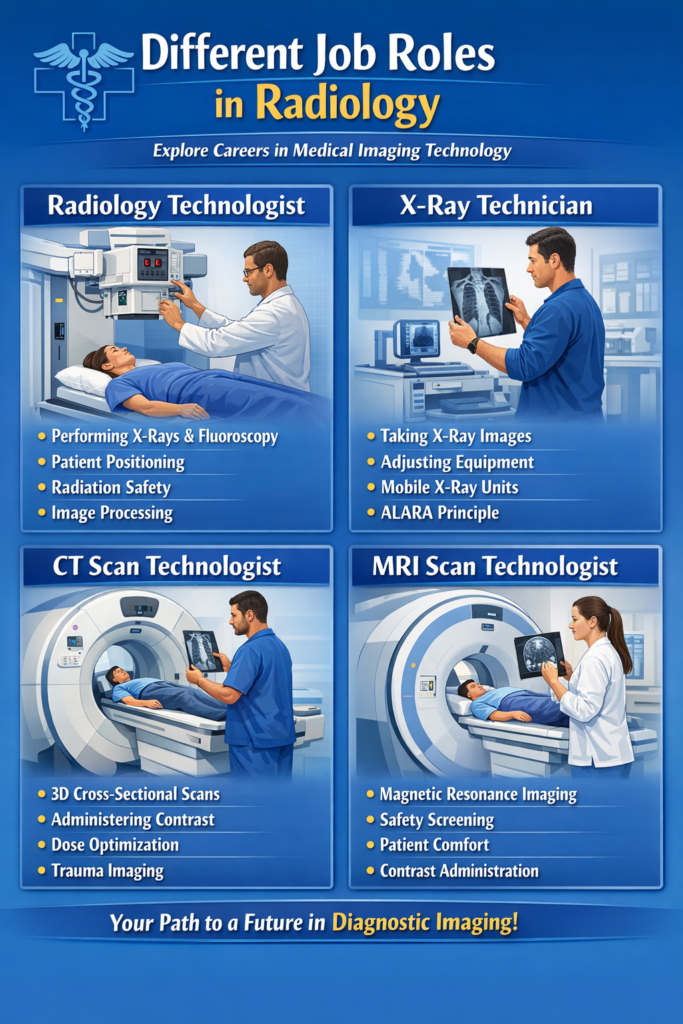
Graduates can focus on a variety of imaging modalities, each with specific needs.
Radiology Technologist
The medical specialist in charge of carrying out diagnostic imaging tests is a radiology technologist, sometimes referred to as a radiographer. The technologist uses radiation-based equipment to make the pictures, while the radiologist evaluates them.
Producing high-quality diagnostic pictures while guaranteeing the patient receives the least amount of radiation is the main objective of a radiology technologist. They serve as a link between patient care and sophisticated technologies.
Key Responsibilities of a Radiology Technologist
- Accurately placing the patient’s body to provide the greatest image of the particular organ or bone that the doctor has asked for.
- In operating rooms or emergency rooms, equipment operation includes calibrating and running X-rays, fluoroscopies, and occasionally mobile imaging units.
- Radiation safety involves determining the appropriate exposure variables (kVp, mAs) and protecting oneself and patients from needless radiation by wearing lead aprons or shields.
- Image processing is the process of developing and “cleaning up” pictures using Digital Radiography (DR) or Computed Radiography (CR) equipment before delivering them to the radiologist.
- Patient Safety & History: Confirming the patient’s identification, determining whether the patient is pregnant (for female patients), and easing the patient’s fear by outlining the process.
X-Ray Technician
An important position in medical imaging is that of an X-ray technician, commonly known as a radiographer. They specialize in producing two-dimensional (2D) pictures of the interior organs and bones of the body using ionizing radiation.
When a patient requires diagnostic imaging, the X-ray technician is their initial point of contact. Their main objective is to minimize radiation exposure while producing precise, clear pictures that assist medical professionals in diagnosing foreign objects, infections, or fractures.
Key Roles of X-Ray Technician
- Patient positioning is the process of moving and helping patients, who can be in pain, to obtain the precise angle required for a clear picture of a particular bone or joint.
- Operating X-ray equipment involves adjusting technical parameters such as voltage (kVp) and current (mAs) according to the region being scanned and the patient’s body type.
- Radiation Protection: Using lead aprons, thyroid shields, and collimation to protect the patient while strictly adhering to “ALARA” (As Low As Reasonably Achievable) guidelines.
- Darkroom/Digital Processing: Creating physical films or, more frequently, processing and uploading pictures to a hospital’s database utilizing Digital Radiography (DR) equipment.
- Mobile X-Rays: Transporting portable X-ray equipment to the operating room, intensive care unit, or emergency room (ER) for immobile patients.
CT Scan Technologist
A highly qualified medical imaging specialist who runs Computed Tomography (CT) scanners is called a CT Scan Technologist, or CAT Scan Technician. They create intricate, cross-sectional 3D pictures of interior organs, bones, and soft tissues using cutting-edge X-ray equipment.
Capturing high-resolution diagnostic pictures while carefully controlling the patient’s radiation exposure and comfort is the CT technologist’s main objective. Due to the use of contrast agents, sophisticated software for 3D reconstructions, and cross-sectional anatomy, this position is more technically challenging than conventional radiography.
Important Responsibilities of CT Scan Technologist
- Operating Advanced Scanners: Accurately obtaining anatomical data by calibrating and operating CT equipment (from manufacturers like GE Healthcare or Siemens Healthineers).
- Contrast media administration involves giving patients radiopaque dyes orally or intravenously to highlight particular organs or blood arteries while keeping a tight eye out for any adverse responses.
- Image reconstruction is the process of transforming raw data into 3D models or cross-sections using specialist software to assist radiologists in identifying internal bleeding, tumors, or complicated fractures.
- Radiation Safety & Dose Optimization: minimizing patient exposure by modifying technical parameters (such as slice thickness) in accordance with the stringent ALARA (As Low As Reasonably Achievable) guidelines.
- Emergency & Trauma Support: Conducting scans quickly in high-stress settings, such as emergency rooms, when prompt imaging is essential for making life-saving choices.
MRI Scan Technologist
A highly skilled specialist, an MRI Scan Technologist (Magnetic Resonance Imaging Technologist), creates comprehensive three-dimensional pictures of a patient’s interior organs and soft tissues using radio waves and strong magnetic fields. This job does not involve ionizing radiation, in contrast to other radiology professions, but it does demand a thorough grasp of complicated physics and magnetic safety.
From checking patients for metallic implants to modifying technological settings to guarantee the best possible picture quality, the MRI technologist is in charge of the whole scanning procedure. Because MRI scans are lengthy (20–90 minutes) and the equipment is noisy and cramped, the technician must also offer patients who might feel claustrophobic or nervous a great deal of emotional support.
Important Duties of MRI Scan Technologist
- Strict Safety Screening: Making sure patients don’t have any contraindications, such as cochlear implants, pacemakers, or metallic shards that might be fatal in a high magnetic field.
- Patient Preparation and Positioning: Using customized “coils” (antennas) for the particular body area being photographed, the patient is positioned precisely, ear protection is provided, and the technique is explained.
- Managing Complex Software: Choosing suitable imaging sequences (T1, T2, FLAIR) and making real-time parameter adjustments to reduce patient movement-related distortions.
- Contrast Administration: Gadolinium-based contrast agents are injected intravenously as needed to improve picture clarity while keeping an eye out for any possible allergic reactions.
Quality Control: Examining pictures for anatomical alignment and technical correctness before sending them to the radiologist’s PACS (Picture Archiving and Communication System).
Role of Radiology and Imaging Technology Students (BRIT)
- BRIT plays a major role in modern healthcare. It entails using advanced imaging technology to diagnose, monitor, and treat medical conditions.
- These radiology professionals are skilled in operating imaging equipment and ensuring high-quality, safe diagnostic images.
- Mammography, ultrasound, CT (Computerized Tomography), MRI (Magnetic Resonance Imaging), and X-ray equipment should all be used.
- Adjust the settings to get clear, accurate photos for diagnosis.
- Prepare patients for surgery: Assure comfort, lessen anxiety, and describe imaging techniques.
- Safety and Radiation Protection: To minimize radiation exposure, follow strict rules.
- Put on safety gear for both yourself and your patients.
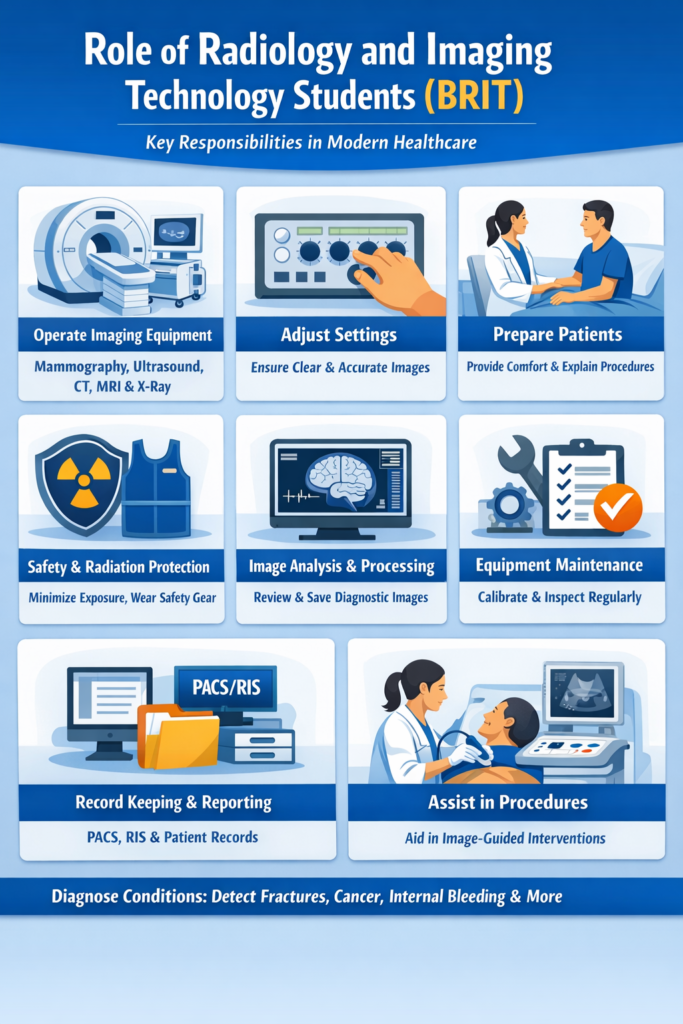
- Image Analysis and Processing: Capture, review, and save medical images.
- Ensure that the picture quality is enough for correct interpretation by radiologists or physicians.
- Provide the right imaging data to radiologists so they can analyze it.
- They are crucial for diagnosing illnesses, internal bleeding, cancer, and fractures.
- Regularly calibrate and inspect imaging equipment.
- Report technical issues or malfunctions as soon as you can.
- Keeping Documents and Reporting
- Maintain patient records and imaging reports.
- Utilize PACS (Picture Archiving and Communication System) and RIS (Radiology Information System).
- Particular Roles in Intervention Methods
- Help with image-guided biopsies or procedures.
- Encourage the use of the least invasive techniques for diagnosis and treatment.
Career in Radiology
In medicine, radiology is a rapidly growing field. Because of its close relationship to contemporary imaging, it benefits from advancements in computer technology. The demand for qualified and experienced radiology technologists in hospitals, clinics, and doctors’ offices has been rising quickly in recent years due to the wide range of employment and career options in this field.
Possessing the following abilities increases a radiologist’s chances of having a successful career:
- Outstanding analytical and visionary abilities.
- Strong technical abilities because they must operate a computer.
- A thorough understanding of human anatomy and medicine as it relates to human health.
- We value interest and a solid foundation in biology, physiology, and anatomy.
Few Career Options After the BRIT Course
- Radiologic Technologist
- MRI Technologist
- CT Technologist
- Mammographer
- Radiation Therapist
- Interventional Radiologic Technologist
- Radiology Manager or Administrator
- Educator
- X-Ray Technician
- Scientific Assistant
- Radiographer
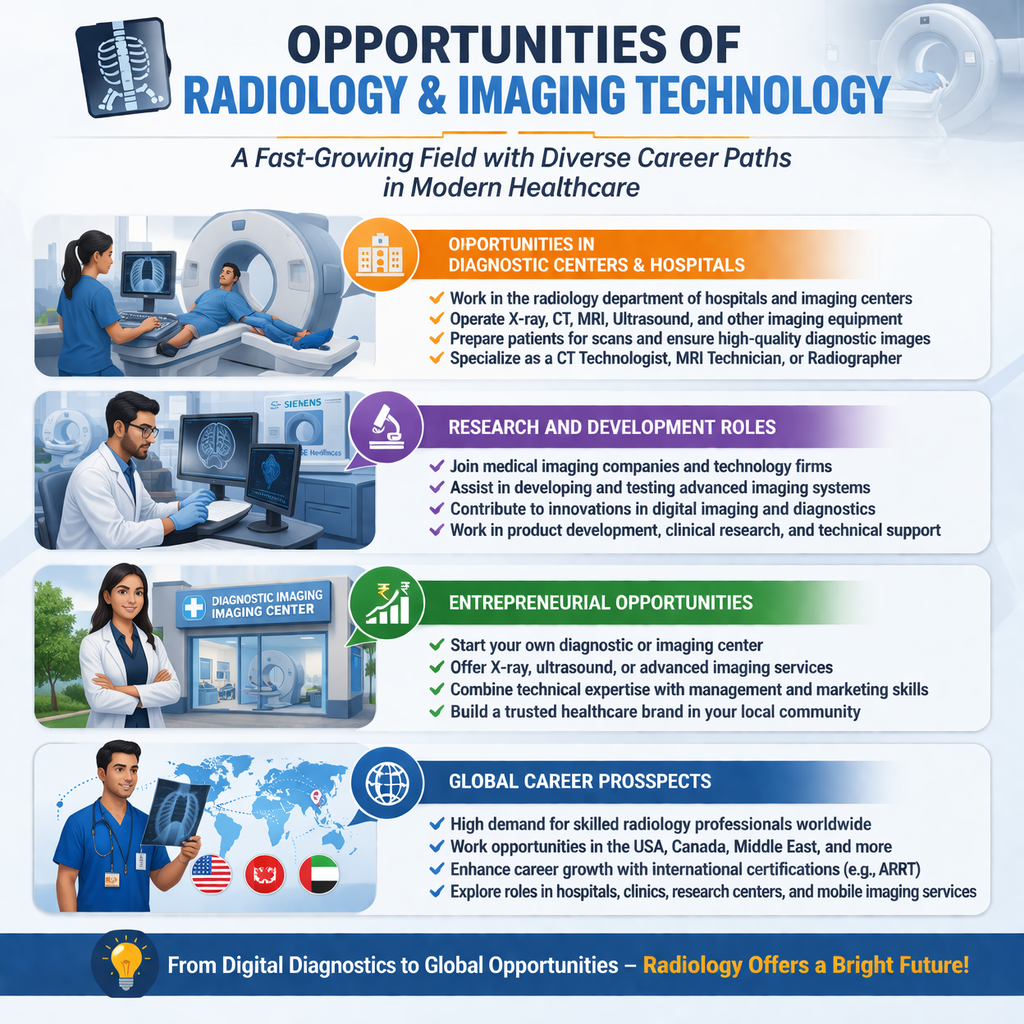
Opportunities of Radiology and Imaging Technology
One of the healthcare industries with the quickest rate of growth is radiology and imaging technology, where prospects have moved from simple X-rays to sophisticated digital diagnostics.
Opportunities in Diagnostic Centers & Hospitals
One of the major workplaces for graduates in radiology is a hospital or diagnostic centre. You can operate imaging equipment, get patients ready for scans, and make sure high-quality pictures are generated while working in the radiology department. For those with additional training or qualifications, specialized positions like CT technologist or MRI technician are also available.
Research and Development Roles
There are possibilities in research and development for those who are interested in innovation. Graduates are employed by imaging equipment manufacturers like Siemens and GE Healthcare to help with the development and testing of new technologies. You can contribute to improvements in medical imaging and diagnostics in this sector.
Entrepreneurial Opportunities
Graduates may open their own imaging facilities or diagnostic clinics if they have enough expertise. This route demands both technical proficiency and business savvy. You may manage your own business and have an influence on healthcare services in your community by operating a diagnostic facility.
Global Career Prospects
A B.Sc. in Radiology and Imaging Technology is a flexible degree that is in high demand worldwide. The United States, Canada, and the Middle East are just a few of the nations that are actively looking for qualified radiology technicians. Your employment chances might be further improved by obtaining international certifications like ARRT (American Registry of Radiologic Technologists).