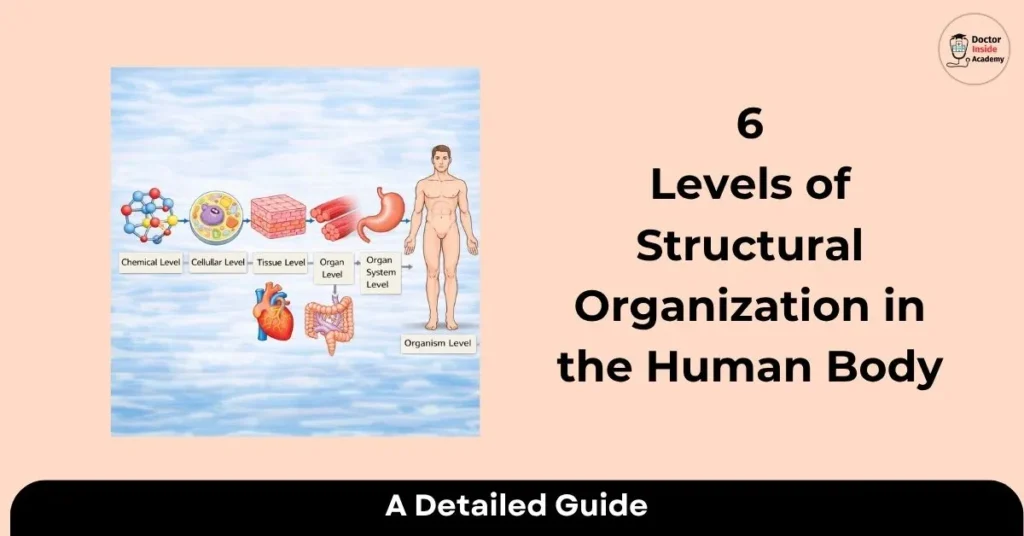
It is useful to think about the basic architecture of the human body, or how its smallest elements are put together to form bigger systems, before you start studying its many structures and functions. The basic layers of organization that develop in complexity, subatomic particles, atoms, molecules, organelles, cells, tissues, organs, organ systems, organisms, and the biosphere, make it easy to think about the body’s structures.
The smallest unit of one or more different chemicals known as elements, which make up all living and non-living things, is the atom. For instance, the element oxygen (O) is composed of O atoms, the element carbon (C) is composed of C atoms, and the element hydrogen (H) is composed of H atoms. Molecules are made up of atoms.
Here, these molecules can be large (such as proteins, which are composed of hundreds of atoms of C, H, and O along with other elements like nitrogen (N)), medium (such as C6H12O6, glucose, which has six atoms of C, twelve of H, and six of O), or small (such as O2, oxygen gas, which has two atoms of the element O; CO2, carbon dioxide, which has one atom of C and two of O). Every structure in the human body is made up of molecules.
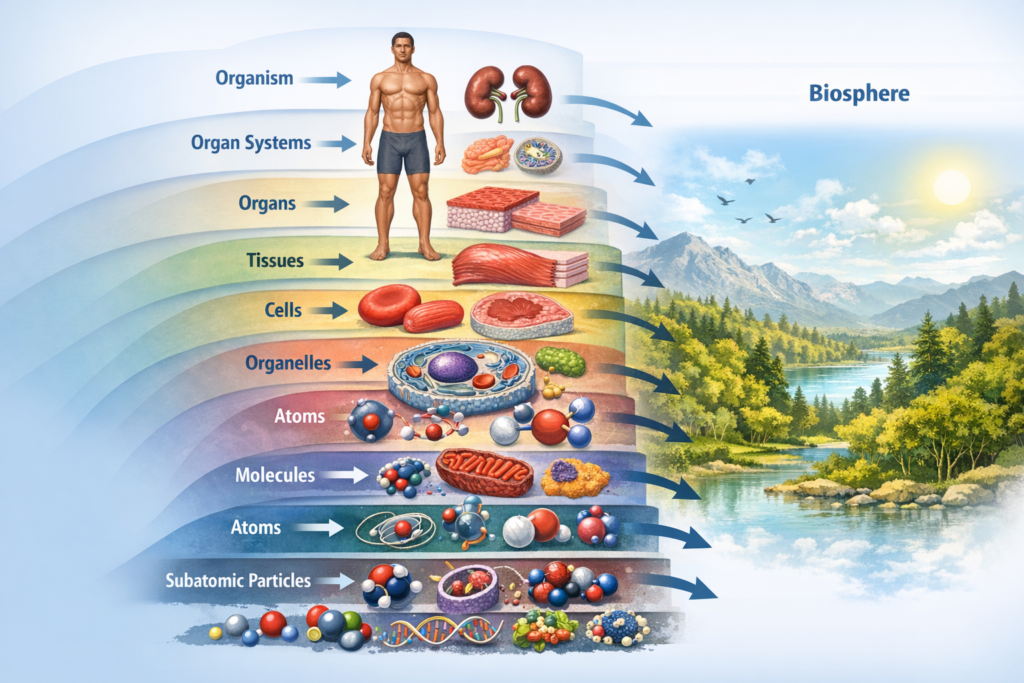
Cells, which are composed of a wide variety of chemicals, make up all living structures. The smallest autonomous living entity in the human body is a cell. The body is composed of several cell kinds, each of which has a specific purpose (for instance, red blood cells deliver oxygen, while muscle cells contract to move an object).
Every human cell is composed of a thin outer layer called the cell membrane, which surrounds a jelly-like cellular fluid that contains microscopic, which are structures. Organelles come in a variety of forms, each serving a specific purpose (for instance, a cell’s mitochondria supply energy).
Depending on their purpose, various cell types have varying numbers and kinds of organelles (muscle cells, for instance, have many mitochondria because they need a lot of energy, whereas skin cells have few).
Six Levels of Structural Organization
The human body can be better understood by dissecting it into its “parts list,” much like a complicated machine. A hierarchy of six layers of structural organization is used by biologists and anatomists to explain how humans develop from minuscule atoms to living, breathing beings.
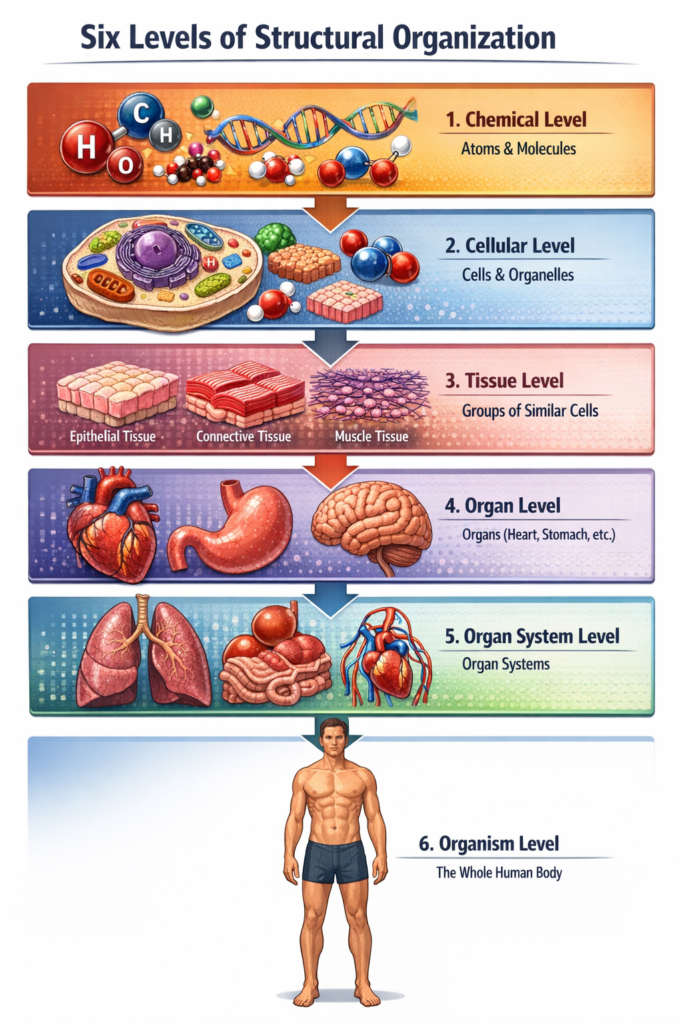
From the small to the whole individual, these stages are broken down in depth here.
Chemical Level (The Foundation)
The body is composed of matter at its most basic level. Atoms, the smallest units of chemical elements (such as carbon, hydrogen, oxygen, and nitrogen), are involved at this level.
These atoms combine to form molecules.
- Water and glucose (sugar) are examples of simple molecules.
- Proteins, lipids (fats), and DNA, which contains your genetic code, are examples of complex macromolecules.
Cellular Level (Life’s Unit)
The smallest autonomous unit of a living being is the cell. Despite their small size, cells include organelles, tiny “organs” like the brain’s nucleus or the power plant’s mitochondria, that carry out unique functions.
- Diversity: Your body has specialized cells for various functions, such as red blood cells to deliver oxygen or neurons to transmit information.
Tissue Level (Fabric)
A tissue is made up of several comparable cells and the surrounding tissue that cooperate to carry out a certain function.
The human body is composed of four main kinds of tissue:
- Epithelial tissue lines internal cavities and covers the exterior of the body (such as the lining of your stomach or your skin).
- Connective tissue, which includes bone, blood, and fat, provides support, binding, and protection.
- Muscle Tissue: Specifically designed for movement and contraction.
- Electrical impulses are sent by nervous tissue to facilitate communication.
Organ Level (Specialized Machine)
An organ is a unique anatomical structure made up of two or more types of tissue. Every organ serves a specific physiological purpose.
- The bladder, for instance. Smooth muscle tissue contracts and expels urine, connective tissue gives it structure and holds it in place, and epithelial tissue lines the interior.
- The brain, stomach, and heart are other examples.
Organ System Level (Team)
An organ system is a collection of organs that cooperate to fulfill essential physiological functions. There are eleven major organ systems in humans, such as the respiratory, cardiovascular, and digestive systems.
- The digestive system is one example. The mouth, esophagus, stomach, small and large intestines, liver, and pancreas are all part of this system.
- Although the functions of each organ vary, they all contribute to the process of breaking down food and absorbing nutrients.
Organism Level (Whole Package)
The greatest level of organization is the organism. All lower levels cooperate harmoniously to sustain life, health, and balance in this living being, a person.
- Every level down to the cells is impacted if one system fails, such as the heart stopping.
- The human body is a work of biological engineering, as demonstrated by the six layers of structural organization.
- The body makes sure that every tiny chemical interaction sustains the existence of the entire organism by coordinating everything from basic atoms to intricate organ systems.
Gaining an understanding of this hierarchy is essential to studying anatomy and physiology because it demonstrates how a breakdown at the smallest level, such as a cellular mutation, can affect an individual’s overall health.
11 Organ Systems with One Organ and Their Main Function
Consider the human body as a vast, technologically advanced metropolis. Power grids, garbage management, transportation, and security are all necessary for the city to function. These are our eleven organ systems in terms of biology.
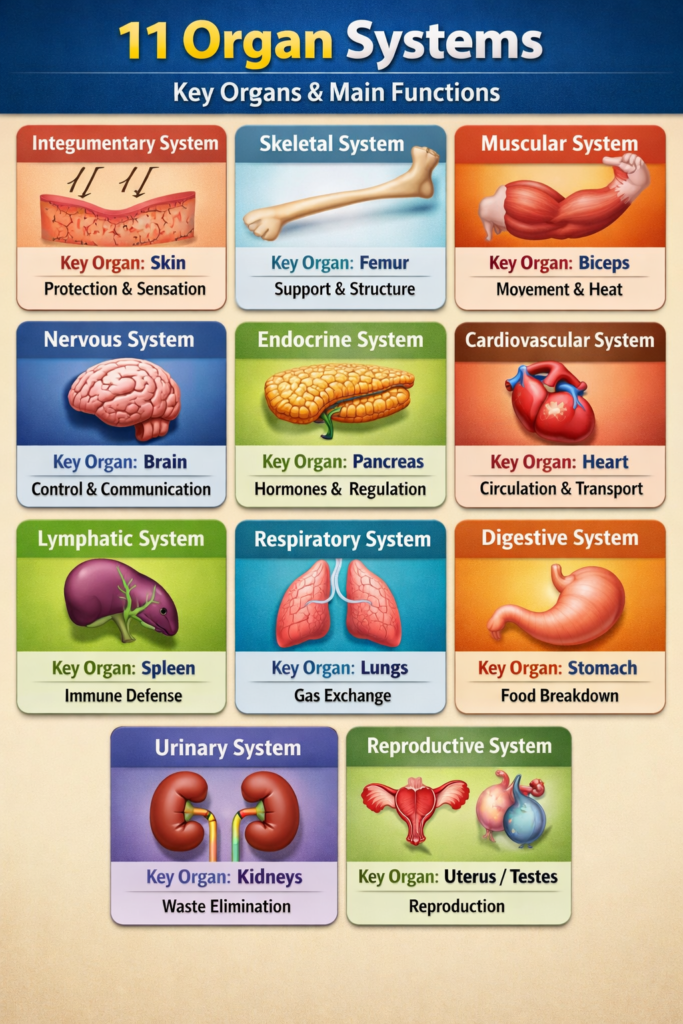
Every system has a “mission” (its principal function) and a “manager” (a primary organ).
This is an explanation of how your body maintains its functionality.
Integumentary System (The Perimeter)
The body’s main interaction with the external environment is the integumentary system. Often referred to as the “Perimeter,” it is the biggest organ system in terms of surface area.
- Key Organ: Skin
- Major Function: It is your body’s first line of defense. It protects internal structures from the outside world, regulates temperature, and houses sensory receptors.
Skeletal System (The Framework)
As the body’s internal “scaffold,” the skeletal system offers a stiff framework for all other systems. The human body would be a mass of soft tissue without it.
- Key Organ: Femur (Thigh Bone)
- Major Function: It provides the structural “scaffolding” for your body. It protects soft organs and acts as a storage site for minerals like calcium.
Muscular System (The Engine)
The body’s “Engine,” the muscular system, transforms chemical energy into power. Although we frequently associate this system with “biceps” and “six-packs,” it is also in charge of several quiet, instinctive internal motions.
- Key Organ: Biceps Brachii
- Major Function: This system is all about movement. It allows you to walk, talk, and lift, while also generating the body heat necessary to keep you warm.
Nervous System (The Control Center)
The body’s high-speed communication network is called the nervous system. Serving as the “Control Centre,” it functions similarly to a supercomputer, receiving, processing, and transmitting signals in milliseconds to maintain control over all other systems.
- Key Organ: Brain
- Major Function: The body’s high-speed communication network. It processes sensory information and sends out split-second commands to the rest of the body.
Endocrine System (The Chemical Messenger)
The body’s long-distance communication system is called the Endocrine System. The Endocrine System employs hormones for long-term, steady management, whereas the Nervous System uses electrical zaps for speed.
- Key Organ: Pancreas
- Major Function: Unlike the fast-acting nervous system, this system uses hormones to regulate long-term processes like metabolism, growth, and blood sugar levels.
Cardiovascular System (The Delivery Service)
As the body’s “Delivery Service,” the cardiovascular system serves as a fast transit system that makes sure each and every cell gets the resources it requires to survive.
- Key Organ: Heart
- Major Function: It acts as a pump, pushing blood through a massive network of vessels to deliver oxygen and nutrients to every single cell.
Lymphatic System (The Defense Force)
The body’s “Defense Force” and backup circulatory system is the lymphatic system. It is crucial for preserving the body’s fluid balance and defending against infections.
- Key Organ: Spleen
- Major Function: This system manages fluid balance by returning leaked fluids to the blood and houses the white blood cells that fight off infections.
Respiratory System (The Air Exchange)
The respiratory system serves as the body’s “Air Exchange,” allowing vital gases to enter and depart the body. It guarantees that each cell has the oxygen required to generate energy.
- Key Organ: Lungs
- Major Function: Its job is simple but vital: pull oxygen into the body for the blood to pick up and expel carbon dioxide waste.
Digestive System (The Power Plant)
As the body’s “Power Plant,” the digestive system transforms food into the energy and building elements your cells require to survive.
- Key Organ: Stomach
- Major Function: It breaks down the food you eat into tiny molecules that the body can actually use for energy and repair.
Urinary System (The Waste Treatment)
The urinary system functions as the body’s “Waste Treatment” plant, a sophisticated filtering system that maintains the ideal equilibrium of your internal chemistry.
- Key Organ: Kidneys
- Major Function: It filters the blood to remove nitrogenous wastes and regulates the amount of water and salt in the body.
Reproductive System (The Legacy)
The only organ system that is not necessary for an individual’s existence but is crucial for the survival of the species is the reproductive system. “The Legacy,” as it is called, is devoted to the biological continuity of life.
- Key Organ: Uterus (Female) / Testes (Male)
- Major Function: Its primary goal is the production of offspring and the secretion of sex hormones to maintain reproductive health.
This is a part of our Anatomy and Physiology Course Notes. The human body is a remarkable illustration of biological engineering, in which basic components serve as the basis for complexity. We can observe that no part of us lives in a vacuum by looking at the body through these six levels of structural order.
Every layer is interconnected, from the organ system level where enormous networks work together to keep us alive to the chemical level where atoms join to generate the blueprint of life. The response of a single molecule may affect a cell, which powers a tissue, which powers an organ, which maintains a system, and finally keeps the creature alive.