For passing the NEET, there are no set passing scores. The cut-off requirements vary from year to year as well as from paper to paper, based on the number of students that showed up, the number of seats that need to be filled, and the paper’s difficulty level.
The NEET percentage required to get into government medical colleges is always changing because they depend on a number of factors, including state quotas, competition level, college tier, and much more. Your job progression depends on passing your 12th-grade exam. However, a lot of entrance tests enable you to grow in your profession and get the job of your dream.
In India, becoming a doctor is one of the most esteemed professions. To become a doctor in India, you must pass the NEET exam. This website serves as your guide to help you understand NEET exam eligibility requirements and percentage if you have a white coat and stethoscope goals.
How Much Percentage is Required for NEET 2025 in Class 12 for Different Categories?
Candidates must also fulfill the National Testing Agency’s (NTA) NEET eligibility requirements to sit for NEET 2025. The minimum percentage needed in Class 12 is one of the main requirements.
Physics, Chemistry, and Biology (PCB) scores determine eligibility, and the necessary percentage varies depending on the category. Physics, Chemistry, and Biology (PCB) are the subjects used to compute this percentage.
Candidates from various categories must meet varying minimum percentage criteria.

How Many Attempts Can I Take for NEET 2026?
Good news: for NEET 2026, there are no limits on the number of attempts. Candidates can appear for the exam multiple times as long as they meet the age requirement of being at least 17 years old by December 31, 2026.
How Many Marks Are Required in NEET for Government Colleges?
The National Testing Agency (NTA) in India administers the required, fiercely contested National Eligibility cum Entrance Test (NEET). It controls admission to all undergraduate medical programs, including MBBS, BDS, AYUSH, and veterinary courses, in both public and private medical schools, acting as the nation’s exclusive doorway for medical education.
The exam is administered offline using pen and paper. Over the course of three hours and twenty minutes, applicants are assessed using multiple-choice questions based on the fundamental physics, chemistry, and biology (botany and zoology) curricula of Classes 11 and 12. Every year, more than 22 lakh candidates vie for a small number of seats, as it totally substitutes separate state-level exams to guarantee an open, merit-based selection process. Because of the enormous number of applicants, NEET is one of the biggest and most competitive exams in the world.
NEET Exam 2026
The National Eligibility and Entrance Test (NEET) is an essential requirement to get enrolled in medical colleges. NEET 2026, an all-India entrance exam, is given to applicants for undergraduate medical schools in India by the National Testing Agency (NTA). Additional details on eligibility, exam format, and syllabus are provided below; make sure you comprehend and adhere to them, as this is a crucial step in gaining admission to your ideal university:
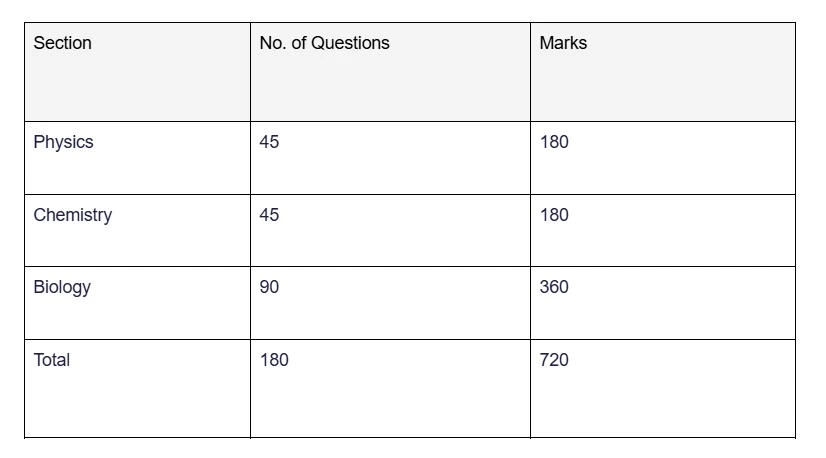
The 180 multiple-choice questions (MCQs) on NEET are broken up into three sections: biology, chemistry, and physics. The exam takes three hours to complete and is administered offline. The exam has a total score of 720.
NEET Score Requirements
For students hoping to get admission to undergraduate medical programs like MBBS and BDS, India’s standard entrance test is the National Eligibility cum Entrance Test (NEET).
Candidates must achieve two distinct requirements to be eligible for a seat: a competitive score out of 720 on the NEET test itself to pass the cutoffs established by different medical institutions, and a specified aggregate score in their Class 12 board exams to qualify for the exam.
- The minimum percentage needed to be eligible for NEET
- Candidates must achieve the following percentage requirements in their 10+2 board exams in order to be eligible for NEET.
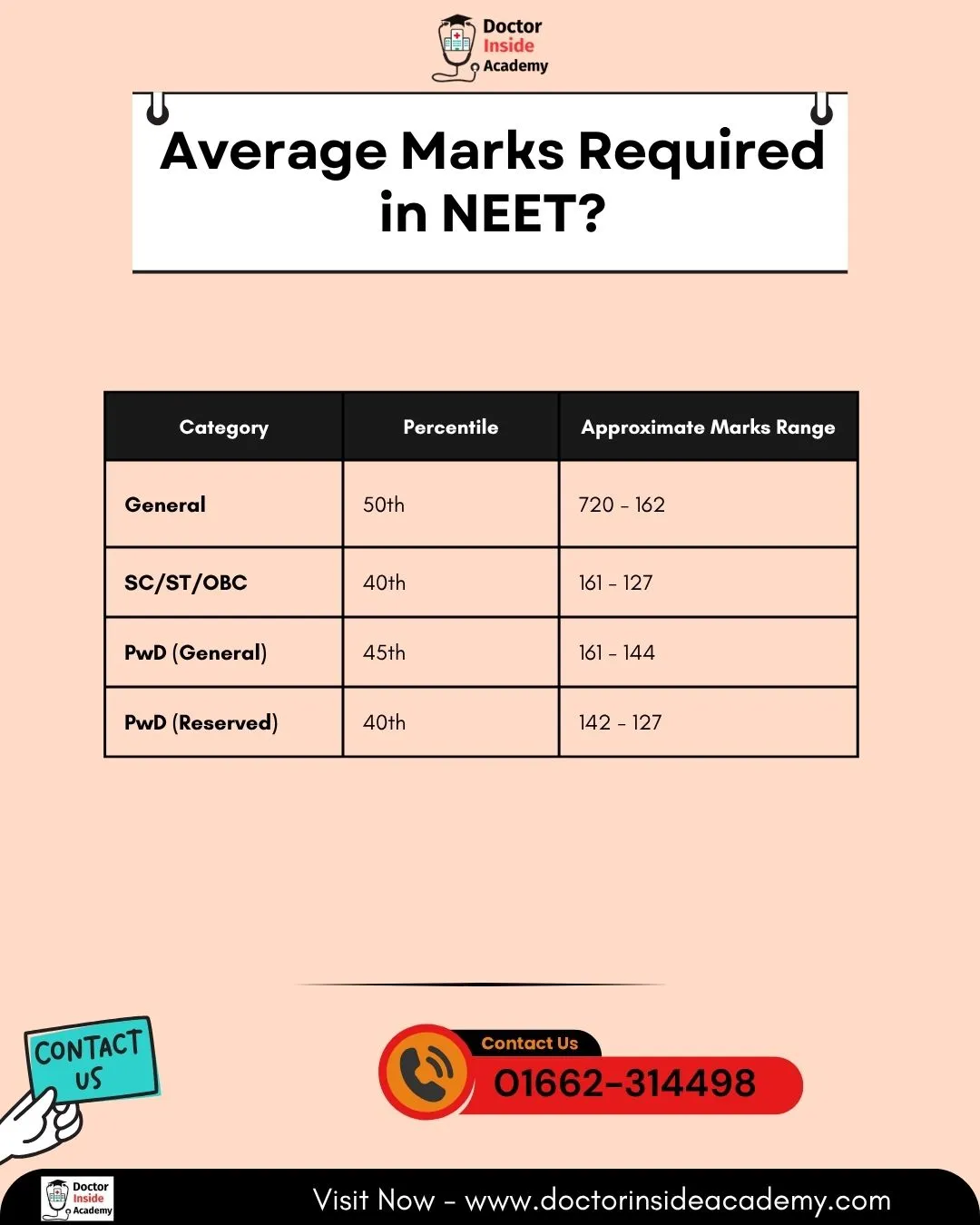
- Unreserved/General Category: Candidates must receive at least 50% of the possible points in Physics, Chemistry, and Biology (PCB).
- OBC/SC/ST Classifications: At least 40% of the possible points in Physics, Chemistry, and Biology (PCB).
- People with Disabilities, or PwD Applicants: PCB must make up at least 45% of the total.
- State-Specific Requirements for MBBS Admission
- Certain Indian states have additional requirements for MBBS admission. For example, certain states might need more entrance examinations or a larger percentage in Class 12.
- Therefore, you must review the particular requirements of the state in which you are applying for the MBBS program.
- Candidates must also achieve the cutoff percentile for that year, so passing the NEET exam alone does not guarantee admission.
- Every year, the NEET cutoff changes according to the exam’s difficulty level and the number of applicants.
Relaxation for Reserved Categories
To provide equal access to medical education, the National Eligibility cum Entrance Test (NEET) provides applicants from reserved categories (OBC, SC, ST, and PwD) with seat reservations and major score relaxations. Both the minimum qualifying percentage required to take part in medical counseling and the Class 12 eligibility marks required to write the test are subject to these relaxations.
- Minimum Marks Relaxation: Compared to students in the general category, SC/ST/OBC candidates receive a 10% reduction in the minimum marks needed to apply for the NEET exam in their 10+2 exam.
- The relaxation also applies to PwD candidates’ 10+2 grades.
- NEET Percentile Relaxation: Compared to candidates in the general category, candidates in the reserved category must have a lower NEET percentile. For the general category, the percentile requirement is 50%, while for SC/ST/OBC, it is 40%.
- Making a Seat Reservation: The proportion of seats set aside for SC, ST, OBC, EWS, and PwD applicants in different Indian government medical schools
NEET Admission Cut-Off
The exact score required to be admitted to a government medical college is known as the admission cut-off. States, categories, and even individual colleges have different numbers. Your chances of being accepted into a prestigious government college increase with your score. However, what specifically affects these admission deadlines?
Let’s have a quick look:
- Number of Candidates: The cut-offs tend to increase as more students vie for the few available seats each year, making the process even tougher.
- Exam Level Difficulty: If the NEET 2025 is more difficult than normal, the cutoff may be a little lower, but there will still be fierce competition for the best universities.
- Category: Students in general categories typically suffer the highest cut-offs, while those in reserved categories (SC, ST, OBC, etc.) typically have a lower qualifying requirement.
- All India Quota (AIQ) against State Quota: AIQ candidates are eligible for 15% of all seats, with a higher cutoff than the State Quota.
- College Reputation: Top-tier and medium-tier universities have very different admission requirements. Top marks are regularly required by prestigious government institutions like AIIMS.
Key Points to Remember for NEET Requirements
- Government colleges are in great demand because of their reputation, affordable tuition, and first-rate facilities.
- To increase your chances of being accepted into a government college, aim for a score that is far higher than the cutoff.
- Keep an eye out for state-specific quotas, which can have a big impact on the number of NEET points needed to get into government colleges.
- You may better prepare for your NEET journey and establish reasonable goals for yourself once you are aware of these benchmarks.
Last Words
It might be difficult to navigate the NEET score criteria, but by breaking them down, you can clearly see your goal. To guarantee exam eligibility, concentrate first on passing your Class 12 board exam. After you have a solid foundation, put all of your attention to increasing your competitive score of 720 to meet the high entrance requirements for the universities you want to attend. So, in this blog, we will learn all about how many marks are required for NEET.
FAQ Related to Percentage Required for NEET?
What Percentage is Required for NEET in Class 12?
In Class 12, candidates must receive at least 50% (UR), 40% (OBC/SC/ST), or 40% (PWD) in Physics, Chemistry, and Biology.
Can a Student Who Failed Class 12 Give the NEET Exam?
No, in order to be eligible for NEET, aspirants must pass Class 12 with the necessary percentage in PCB subjects.
How Many Percentage Required for NEET in 12th Board Exam?
To be eligible for the NEET exam, you must score a minimum aggregate percentage in Physics, Chemistry, and Biology (PCB) combined in your Class 12 board exams. The required percentages by category are: General / EWS: Minimum 50% aggregate marks in PCB.OBC / SC / ST: Minimum 40% aggregate marks in PCB.PwD (Persons with Disabilities): Minimum 45% aggregate marks in PCB.
For 2024-2026, the Minimum Percentage for NEET?
- 50% aggregate in PCB for General and EWS.
- PCB: 40% aggregate for OBC, SC, and ST.
- PCB aggregate in general-PwD is 45%.
- 40% aggregate in PCB is reserved for PwD (SC/ST/OBC-PH).