In anatomy and physiology, one of the first and most important phases is to understand anatomical and physiological directional terminologies. So that health care professionals can effectively define the location of bodily structures using these terminologies, which offer a global language.
If you are a student of radiography, nursing, or medicine, learning directional terms will make understanding anatomy and physiology easier.
Understanding Directional Terms
Standardized anatomical terminologies known as “directional terms” are used to describe the location, interaction, and position of different parts of the body.
- They Eliminate Confusion.
- They Provide Precise Communication.
- They are always used with the body in anatomical position.
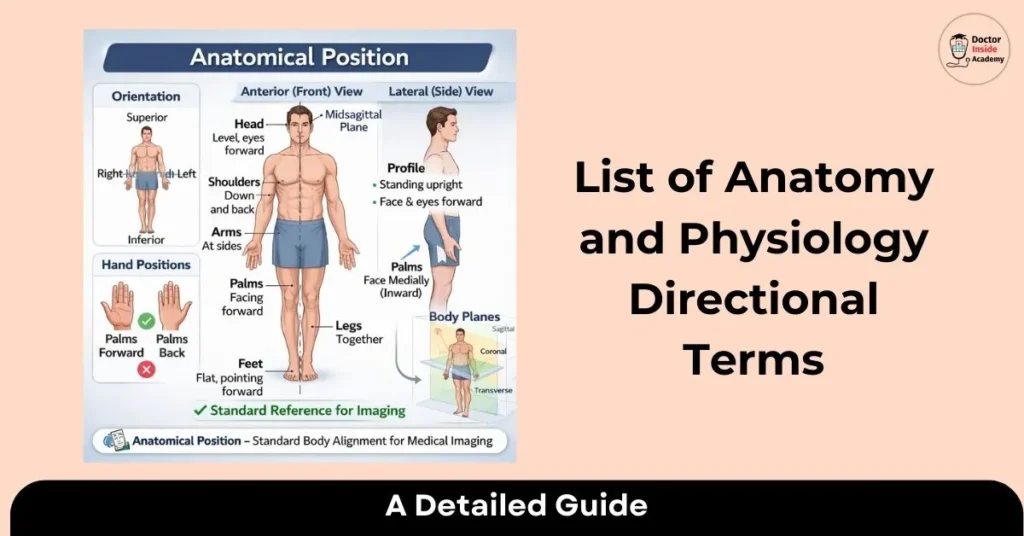
Anatomical Position
No matter a patient’s actual positioning, the anatomical position is the standard reference posture that scientists and medical professionals use to effectively describe bodily parts and their positions.
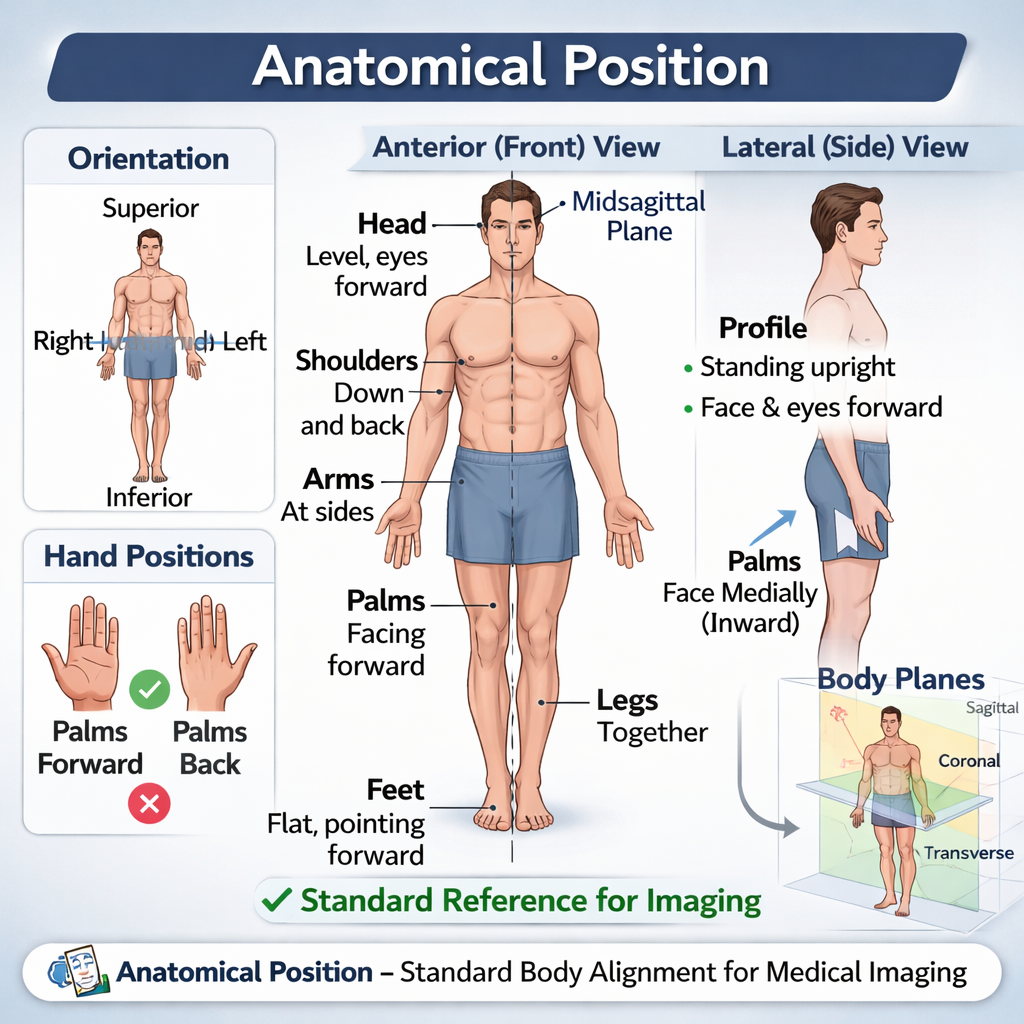
Key Aspects of Anatomical Position
The body is characterized as follows in this typical posture;
- Body Posture: Facing ahead while standing straight and erect.
- Head and Eyes: Maintaining a neutral look while facing straight ahead.
- Arms: The arms are positioned at the sides of the body, hanging straight down.
- Hands: Thumbs pointing away from the body, palms facing forward (anteriorly).
- Feet: Toes pointing forward, feet should be parallel to each other and flat on the ground, either together or slightly apart.
Why Anatomical Position Matters?
Ensures Accurate Communication: It makes it possible for doctors, radiologists, and surgeons to effectively express orientation and position, which is essential for patient safety and lowering medical mistakes.
Eliminates Postural Uncertainty: Because the terms always relate to the physical position, it doesn’t matter how a patient is positioned; even if they are performing a headstand, the head is always seen as superior to the feet.
Standardizes Medical Records: Using this “baseline” in written reports ensures that any expert who might read the report later will know precisely which structures are being discussed.
Clinical and Surgical Accuracy: It is crucial for accurate surgical planning to prevent harm to surrounding organs or tissues, as well as for properly detecting and diagnosing injuries in medical imaging (such as MRIs or CT scans).
Universal Language for Education: By giving researchers and students a standardized “anatomical alphabet,” Universal Language for Education enables the clear examination of intricate systems like nerve routes and muscle attachments.
Anatomy: Directional & Positional Terms
These describe where things are located in the body.
- Superior / Inferior: Toward the head / Toward the feet.
- Medial / Lateral: Toward the midline / Away from the midline.
- Anterior (Ventral) / Posterior (Dorsal): Toward the front / Toward the back.
- Proximal / Distal: Nearer to / Farther from the trunk (used for limbs).
- Cranial (Cephalad) / Caudal: Toward the head / Toward the “tail” (lower spine).
- Superficial / Deep: Toward the surface / Away from the surface.
- Visceral / Parietal: On the organ itself / On the wall of the body cavity.
- Bilateral / Unilateral: On both sides / On one side.
- Ipsilateral / Contralateral: On the same side / On the opposite side.
- Volar (Palmar) / Plantar: Relating to the palm / Sole.
Physiology: Movement & Action Terms
These describe how the body moves and functions.
- Supine / Prone: Lying/facing up (on back) / Lying/facing down (on belly).
- Flexion / Extension: Decreasing a joint angle / Increasing a joint angle.
- Abduction / Adduction: Moving a limb away from midline / Moving toward midline.
- Internal / External Rotation: Turning a limb toward the center / Turning away.
- Dorsiflexion / Plantarflexion: Pulling toes up / Pointing toes down.
- Inversion / Eversion: Turning the sole inward / Turning the sole outward.
- Protraction / Retraction: Pushing a part (like the jaw) forward / Pulling it back.
- Elevation / Depression: Raising a body part / Lowering a body part.
- Circumduction: Moving a limb in a circular “cone” shape.
- Afferent / Efferent: Signals moving toward the brain / Signals moving away to muscles.
A Few Common Questions About the List of Anatomy and Physiology Directional Terms
What are Anatomical Directions?
Generally, based on the reference position of the anatomical posture (standing upright, looking forward, arms at the sides, palms facing forward), anatomical directions are standardized words used to describe the location or orientation of structures in the human body. Healthcare and fitness experts can more accurately explain movement and body parts by usingthise terminology.
What is the significance of anatomical directions?
Accurate communication is crucial in the fields of anatomy, exercise science, medical imaging, and physical assessment. Professionals can communicate more quickly and properly if they have a clear way to explain, for instance, that the wrist is distal to the elbow or that the heart is medial to the lungs.
How do medial and lateral differ from one another?
“Medial” denotes being nearer the midline of the body, whereas “lateral” denotes being farther away. For example, the shoulders are positioned laterally to the neck, while the nose is positioned medially to the eyes.
What are ventral and dorsal?
In general, “ventral” refers to the front or belly side, whereas “dorsal” refers to the back (or top surface in animals). “Dorsal” and “top surface” are frequently used interchangeably in human anatomy, whereas “ventral” is occasionally used to describe the front of the trunk.