Radiation is used in every examination in the radiology department, and we know that radiation has many risks, which can lead to normal tissue damage and cancer to a greater extent. So, to prevent patients from this radiation, dose optimization is necessary. A small amount of radiation can damage DNA easily or may impact the individual’s health negatively.
To take care of radiation, a principle called the “ALARA Principle” was introduced and followed by every radiographic professional to protect themselves and their patient from unwanted exposure.
What is the ALARA Principle in Radiology?
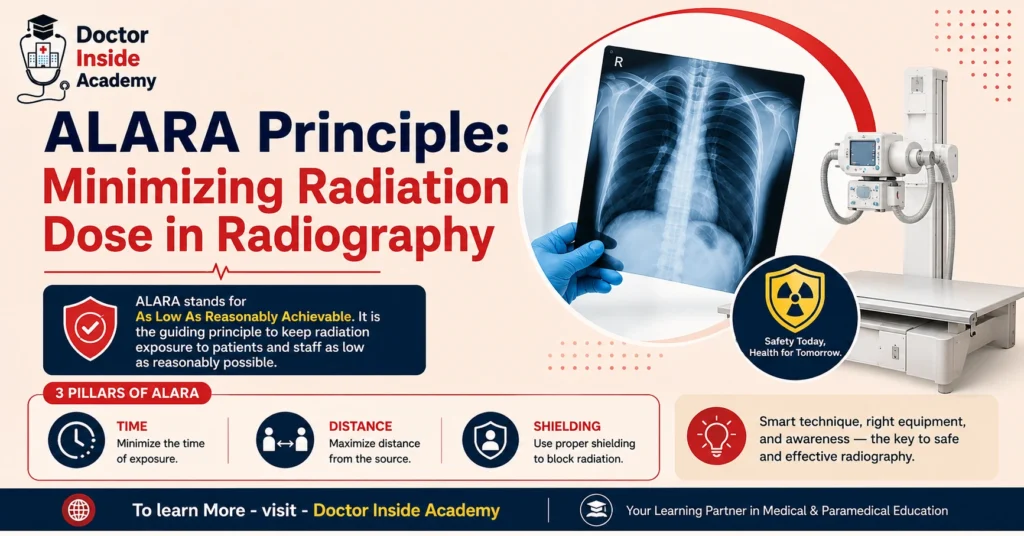
ALARA is a basic principle of radiation protection that expands as“As Low As Reasonably Achievable”. This simply refers to optimizing the radiation exposure for every examination and using as much as possible with a proper distance between the X-ray image receptors to source.
The ALARA principle is a fundamental concept because it prevents two things: unwanted exposure and overexposure to radiation. As radiation is not safe for children and pregnant women, it also impacts the elderly.
It is also known as the universal safety principle.
ALARA Concept by ICRP
One of the three main pillars of the International Commission on Radiological Protection’s (ICRP) system of radiological protection is the Optimization of Protection, which is practically applied via the ALARA principle (As Low As Reasonably Achievable).
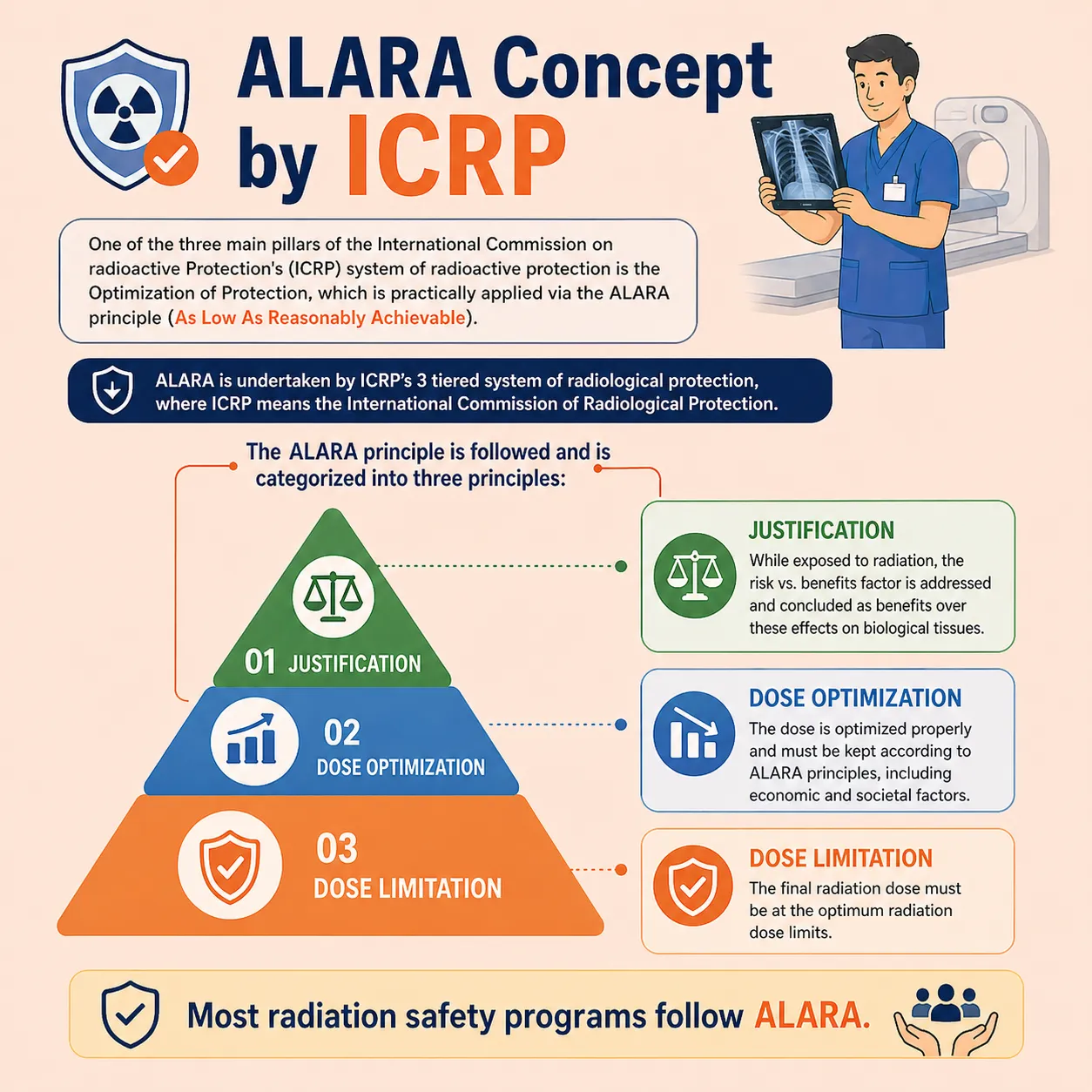
ALARA is undertaken by ICRP’s 3-tiered system of radiological protection, where ICRP means the International Commission on Radiological Protection.
Most radiation safety programs follow ALARA.
- Justification
While exposed to radiation, the risk vs. benefits factor is addressed and concluded that benefits outweigh these effects on biological tissues.
- Dose Optimization
The dose is optimized properly and must be kept according to ALARA principles, including economic and societal factors.
- Dose Limitation
The final radiation dose must be within the optimum radiation dose limits.
The ALARA principle is followed, whether a smaller exposure is taken, and is categorized into three principles. These are as follows.
Cardinal Principles of ALARA
The three main strategies for lowering radiation exposure are the Cardinal Principles of ALARA. These physical techniques assist patients and medical professionals in maintaining the lowest dosage feasible throughout a treatment.
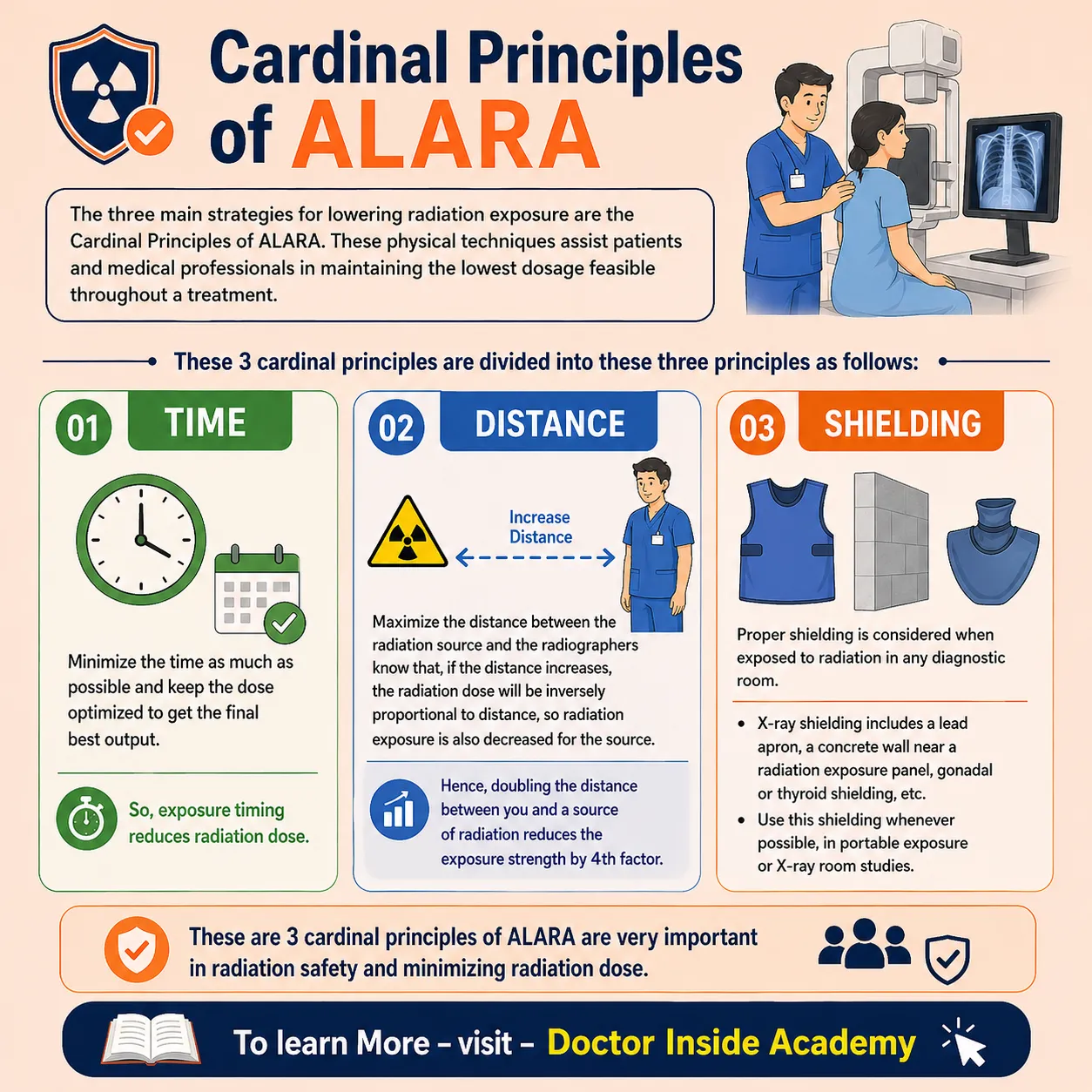
These 3 cardinal principles are divided into the following three principles as follows:
Time
Minimize the time as much as possible and keep the dose optimized to get the best final output.
So, exposure timing reduces radiation dose.
Distance
Maximize the distance between the radiation source and the radiographer. Radiographers know that if the distance increases, the radiation dose will be inversely proportional to distance, so radiation exposure is also decreased from the source.
Hence, doubling the distance between you and a source of radiation reduces the exposure strength by 4th factor.
Shielding
Proper shielding is considered when exposed to radiation in any diagnostic room.
X-ray shielding includes a lead apron, a concrete wall near a radiation exposure panel, gonadal or thyroid shielding, etc.
Use this shielding whenever possible, in portable exposure or X-ray room studies.
These are 3 cardinal principles of ALARA are very important in radiation safety and minimizing radiation dose.
Key Components of the ALARA Principle
The ALARA principle, which operates on the fundamental tenet that even the lowest radiation dose should be avoided if it does not enhance a patient’s medical result, is the gold standard for radiation safety. It is put into practice by combining strict clinical judgment with physical strategies like time, distance, and shielding.
Practitioners may drastically reduce dosage levels by using lead barriers, minimizing exposure duration, and increasing the distance between the source and the person. Additionally, ALARA necessitates a proactive optimization strategy in which equipment parameters such as kVp and mAs are carefully adjusted to match a patient’s size, guaranteeing that the picture is clear enough for a diagnosis without supplying a single “extra” photon of needless radiation.
Here are a few key components of the ALARA principle:
Minimized Radiation Dose
The main goal of the ALARA principle is to minimize radiation and take the exposure to a very minimum required dose to get better diagnostic X-ray images.
It always assures the potential risk of radiation by balancing the final medical imaging outputs.
Personalized Approach
Every patient is unique and has different factors like age, sex, prior history of illness or disease, or clinical history.
These are all taken into account when the ALARA principle is applied; it takes care of every patient with personalized exposure factors.
Dose Optimization
Every exposure requires different exposure values to take the proper image. With the implementation of the ALARA principle, minimum exposure time is achieved with proper selection of tube current, or based on clinical references.
Radiation Safety Measures
The third ALARA principle is about proper shielding to prevent direct radiation exposure.
This prevention includes lead shielding like lead aprons, thyroid shielding, gonadal shields, etc; collimation.
These devices or materials keep the radiation focused and reduce unwanted radiation exposure to the surrounding tissues.
Regular Maintenance
Proper review and improvement must be applied with the ALARA principle to best results in radiology.
These improvements include regular monitoring, quality assurance, and taking care of advancements in technology to achieve dose reduction and dose optimization.
The ALARA principle also includes keeping records of radiation doses.
These are a few key components of the ALARA principle and are very important to execute the ALARA principle properly in radiology.
Benefits of ALARA
By dramatically reducing the long-term danger of radiation-induced sickness, the ALARA concept strikes a compromise between maximal safety and life-saving diagnoses, especially for vulnerable young patients. It builds patient confidence while insulating medical personnel from cumulative occupational dangers through the use of time, distance, and shielding. In the end, ALARA makes sure that each scan is both technically and morally sound, yielding unambiguous findings with the least amount of danger.
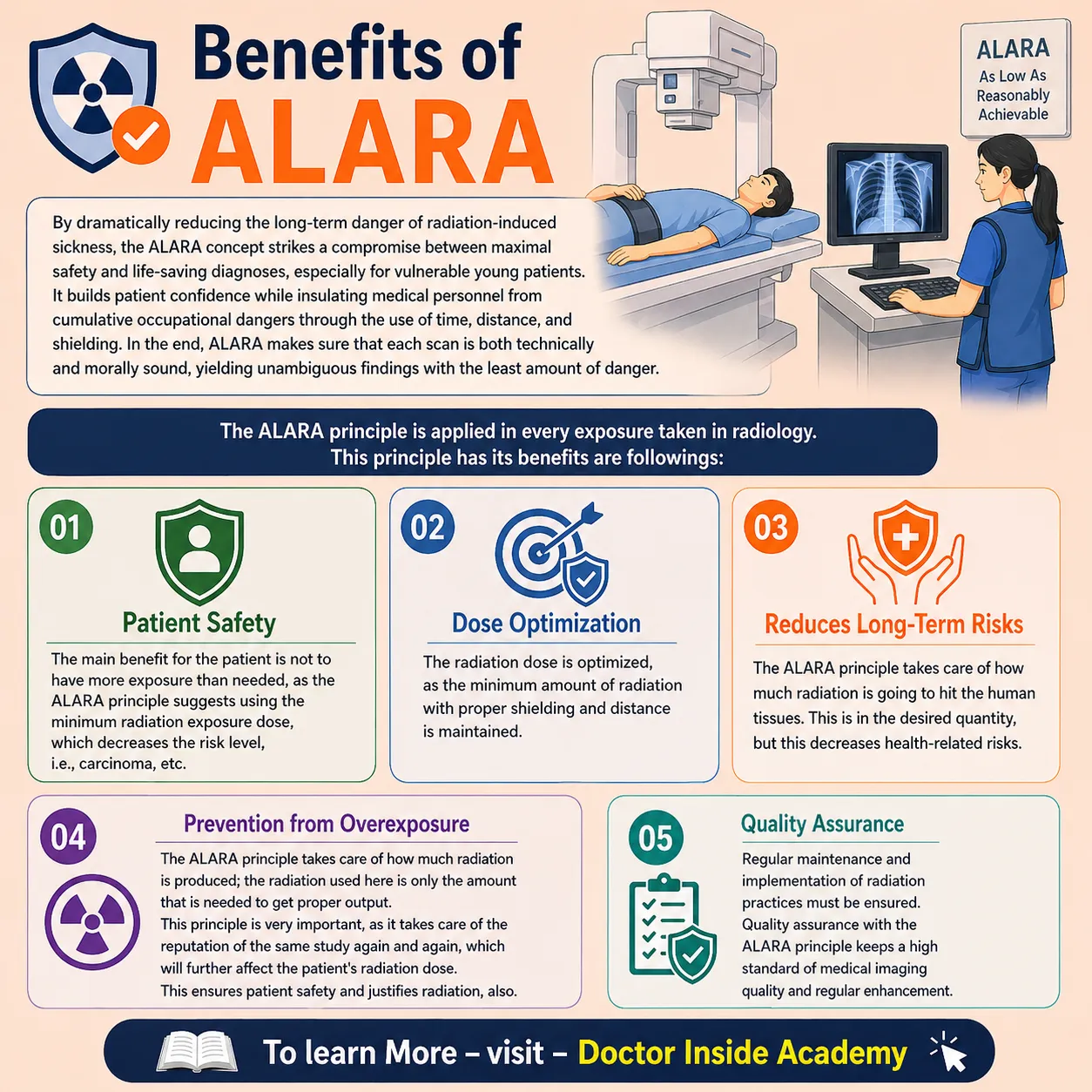
The ALARA principle is applied in every exposure taken in radiology. This principle has the following benefits:
Patient Safety
The main benefit for the patient is not to have more exposure than needed, as the ALARA principle suggests using the minimum radiation exposure dose, which decreases the risk level, i.e., carcinoma, etc.
Dose Optimization
The radiation dose is optimized, as the minimum amount of radiation with proper shielding and distance is maintained.
Reduces Long-Term Risks
The ALARA principle takes care of how much radiation is going to hit the human tissues. This is the desired quantity, but it decreases health-related risks.
Preventionofm Overexposure
The ALARA principle takes care of how much radiation is produced; the radiation used here is only the amount that is needed to get proper output.
This principle is very important, as it takes care of repeating the same study again and again, which will further affect the patient’s radiation dose.
This ensures patient safety and justifies radiation, also.
Quality Assurance
Regular maintenance and implementation of radiation practices must be ensured. Quality assurance with the ALARA principle keeps a high standard of medical imaging quality and regular enhancement.
These are a few benefits of ALARA.
Risks for ALARA
Every coin has two faces; likewise, the ALARA principle has a few risks involved with its benefits, the following:
Proper Balancing
It’s very important to keep a balance between minimizing radiation exposure and ensuring proper image quality assurance.
Sometimes, improper selection of radiation factors leads to inadequate X-ray image output.
Financial Efforts
Implementing advanced strategies and upgrading equipment for dose reduction leads to financial expenses for the hospital or center.
Education
Lack of training and education leads to improper use of ALARA to reduce radiation exposure with safety measures.
Proper training and workshops are very important to understand ALARA principles properly.
X-ray Image Noise
Reducing radiation while adjusting lower exposure factors sometimes leads to an increment in X-ray image noise. This further leads to improper diagnoses of X-ray images.
These are a few risks of the ALARA principle, along with the benefits above.
Why is it Important to follow the ALARA Principle?
Following the ALARA principle is critical because it treats radiation safety as an ethical and biological priority rather than just a legal requirement. The ALARA principle is used to minimize the radiation exposure of radiographers and patients to the public.
Prevents Biological Damage
It uses the “Linear No-Threshold” model, which is predicated on the idea that radiation poses no danger at all. Reducing dosage directly lowers the likelihood of long-term hazards, including cancer and DNA alterations.
Protects Vulnerable Populations: Because of their fast cell division, children and younger patients are far more vulnerable to radiation. ALARA makes sure their cumulative lifetime exposure stays as minimal as feasible.
Ensures Staff Safety
Over the course of a lengthy career, it protects healthcare personnel from long-term exposure that might cause occupational diseases, including radiation-induced cataracts or skin damage.
Standardizes Care
By requiring practitioners to employ optimization, it prevents needless medical expenses and recurrences by guaranteeing that pictures are high enough for a diagnosis without “over-radiating” the patient.
How to Apply the ALARA Principle?
The ALARA principle is followed by its 3 cardinal principles, where these 3 are introduced in detail below.
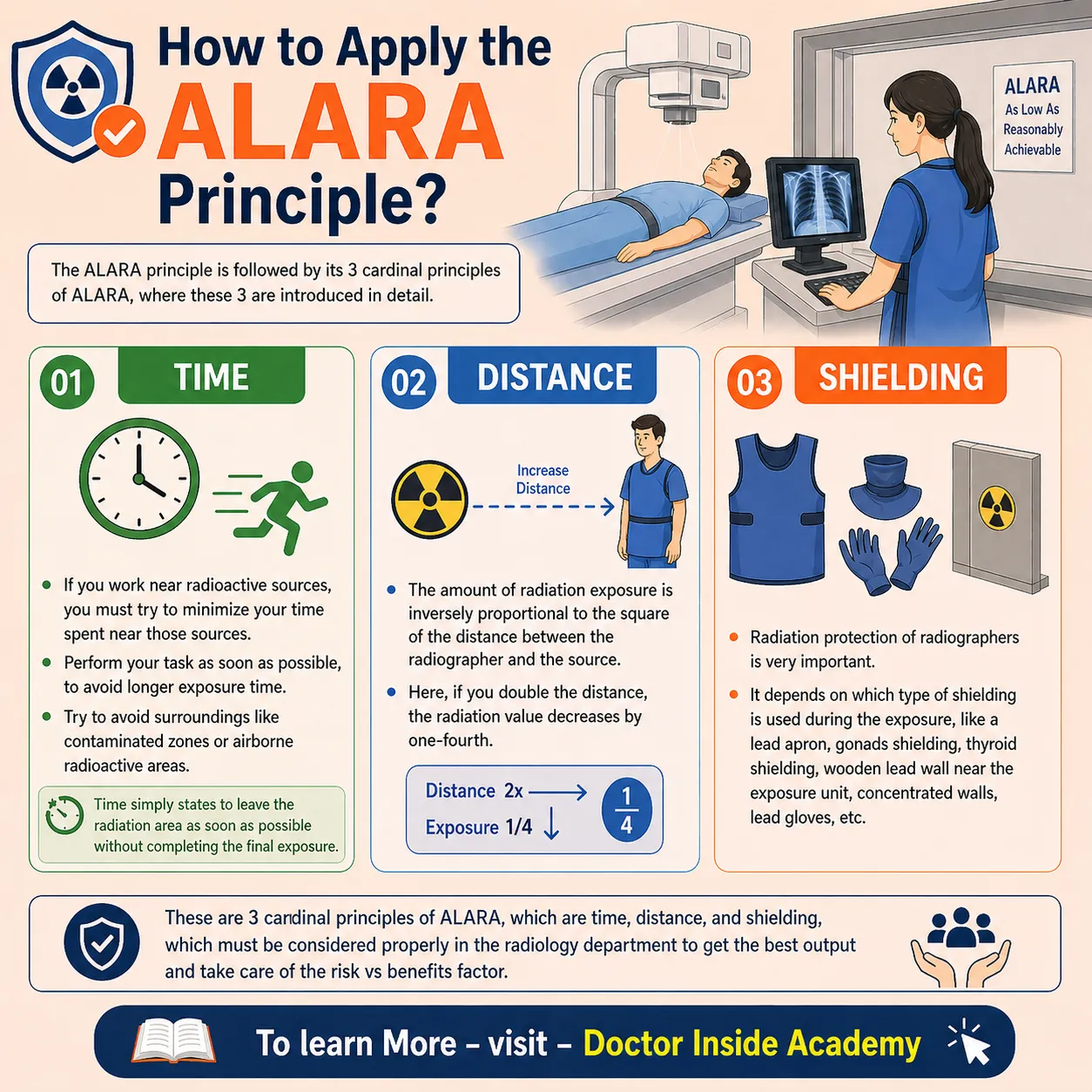
Time
- If you work near radioactive sources, you must try to minimize your time spent near those sources.
- Perform your task as soon as possible to avoid longer exposure time,
- Try to avoid surroundings like contaminated zones or airborne radioactive areas.
Time simply states to leave the radiation area as soon as possible without completing the final exposure.
Distance
- The amount of radiation exposure is inversely proportional to the square of the distance between the radiographer and the source.
- Here, if you double the distance, the radiation value decreases by one-fourth.
Shielding
- Radiation protection of radiographers is very important. It depends on which type of shielding is used during the exposure, like a lead apron, gonadal shielding, thyroid shielding, a lead wall near the exposure unit, concrete walls, lead gloves, etc.
These are 3 cardinal principles of ALARA: time, distance, and shielding, which must be considered properly in the radiology department to get the best output and take care of the risk vs benefits factor.
How to Protect Yourself from Radiation?
As we know, the ALARA principle is used to control radiation exposure, but it does not ensure that any amount of radiation is not harmful to biological tissues.
If you are a radiographer, radiologist, trainee, hospital staff, etc, you must be aware of radiation risks.
Here are a few radiation safety measures you must follow:
Radiation Safety Measures
- Try to reduce the radiation production or usage,
- According to the ALARA principle, use as little as possible,
- Try to isolate yourself from direct radiation exposures,
- Choose the best exposure factors to lower the radiation risks.
Proper Hygiene
- Avoid ingestion of radioactive materials intentionally or accidentally,
- Try not to eat anything in the radioactive area, like food or drinks,
- Wash hands and avoid hand-to-mouth habits; if you have, this limits the risk level of radiation exposure.
Control of Contamination
- Proper disposal of radioactive substances,
- Label radioactive substances and zones properly,
- Proper rules and regulations must be applied in radioactive areas.
- Avoid inhalation of radioactive substances through the respiratory system.
Use of PPE
- PPE stands for Personal Protective Equipment
- It includes an apron, eyewear, and protective gloves, and helps to reduce ingestion or cut off direct contact with the radioactive substances.
If these are followed, then radiation protection is assured, because medical staff protection is very important when working around radiation. ALARA also takes care with time, distance, and shielding.
Application of ALARA in General Radiography
The ALARA principle is very useful in radiation safety, and this is very helpful for patients and the public.
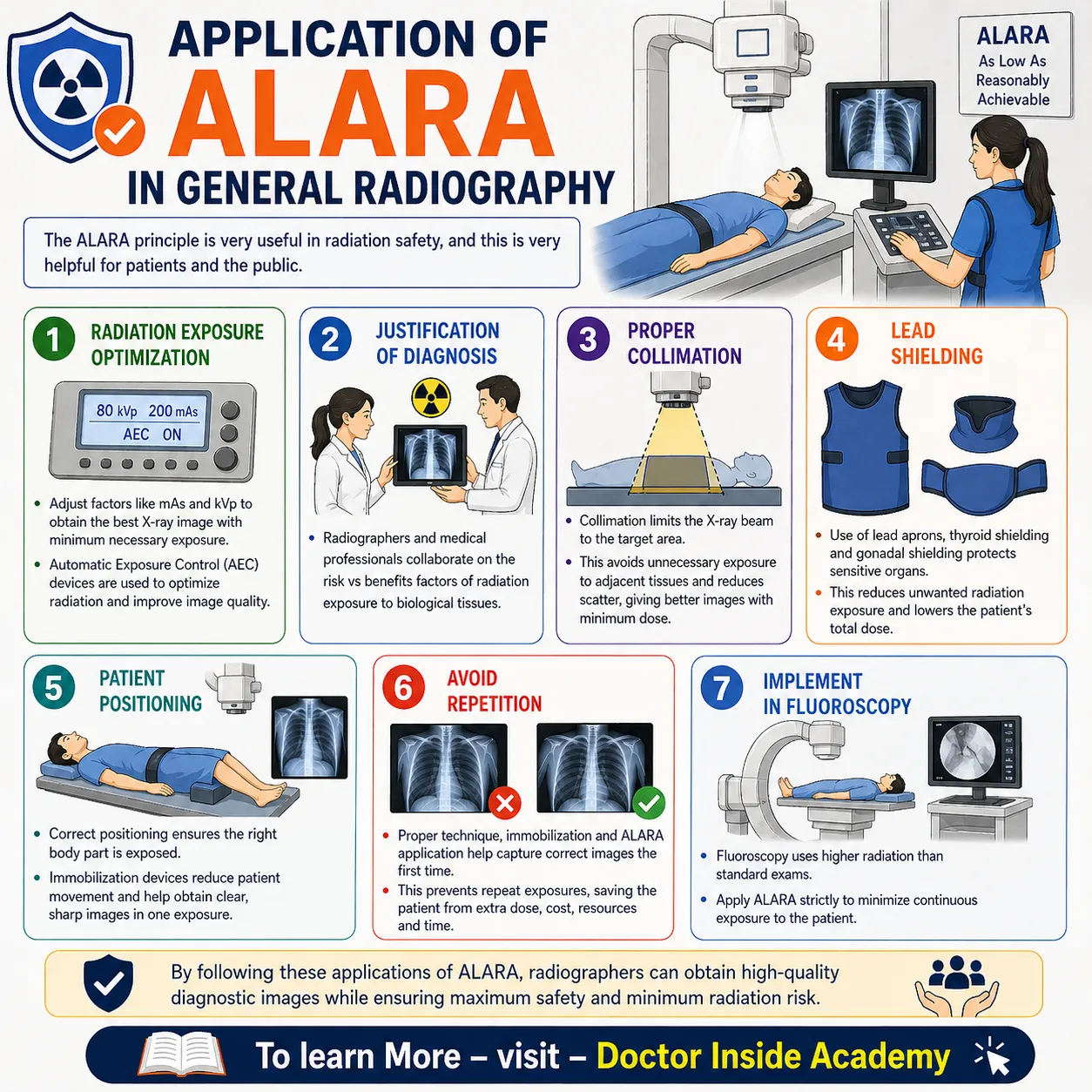
Here are a few applications of the ALARA principle in general radiology:
Radiation Exposure Optimization
Many exposures, like mAs(milliampere-seconds) and KvP(kilovoltage peak), are adjusted to get the best X-ray image with proper exposure optimization, in line with the ALARA principle. Automatic Exposure Control devices are embedded in radiography systems to enhance the radiation exposure to get better diagnostic X-ray images.
Justification of Diagnosis
Radiographers and medical professionals collaborate on the risk-versus-benefit factors of radiation, such as exposure of biological tissues to radiation.
Proper Collimation
Collimation is a concept of optimizing the X-ray beam towards the target source. It helps avoid unwanted radiation exposure to adjacent tissues and reduces radiation scattering. These help in better diagnostic images with minimal radiation to the patients.
Lead Shielding
Lead shielding used in radiology includes lead aprons, thyroid shielding, and gonadal shielding. These are used to protect sensitive organs from unwanted radiation exposure during medical imaging exams. Along with these devices, always take care of the patient’s radiation dose, which will lead to a reduction in the radiation dose.
Patient Positioning
Patient positioning is very important to get better diagnostic results, as positioning ensures the right body part is going to be exposed. Many immobilization devices are also used to stabilize the body part, and these reduce movement to zero, which helps to obtain the best still X-ray images.
Avoid Repetition
Proper patient positioning, use of immobilization devices, and use of the ALARA principle effectively reduce the radiation dose of every exposure. As these give final diagnostic images at once, this saves the patient from additional radiation doses and also saves cost, resources, and time for health care.
Implement in Fluoroscopy
Fluoroscopy uses higher radiation than usual diagnostic exams. Here, the ALARA principle must be accounted for to minimize the continuous radiation exposure to the patients.
These are a few applications considered while using the ALARA principle in radiography, as it helps radiographers obtain the best diagnostic X-ray images and take care of unwanted radiation exposure.
Last Words
The ALARA principle plays a very critical role in radiation safety and minimizing radiation exposure for the patient and the public.
In this chapter of X-Ray Notes, we studied the ALARA principle in depth, with its 3 cardinal principles, benefits, risks, and applications, along with how anyone can protect themselves from radiation effectively.
I hope you learned something new today. Stay connected to learn more daily.