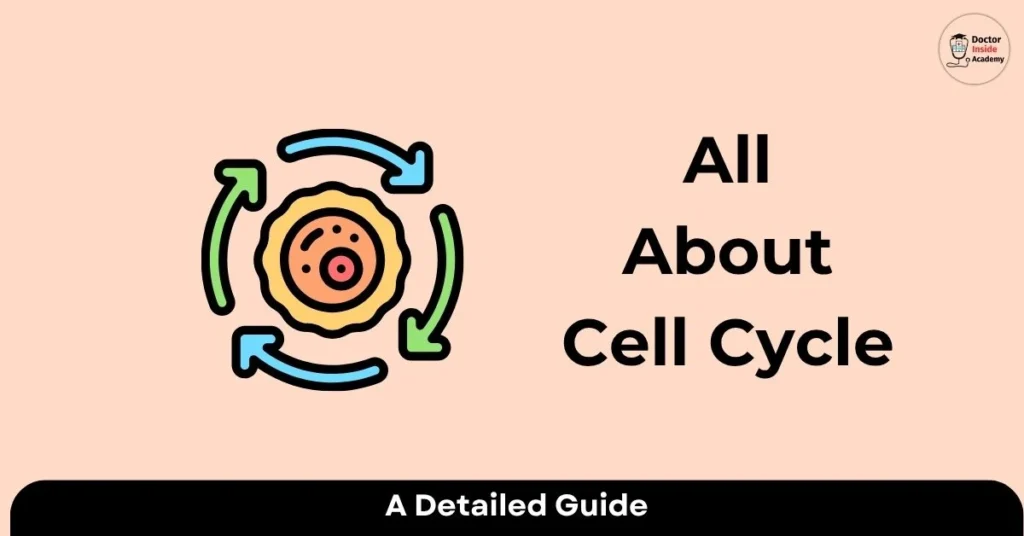
The cell cycle is an ordered sequence of events that results in two new daughter cells through cell division and expansion. In order to create two identical (clone) cells, cells on the way to cell division go through many highly controlled and scheduled steps of growth, DNA replication, and nuclear and cytoplasmic division.
Interphase and the mitotic phase are the two main stages of the cell cycle. DNA replication and cell growth occur during interphase. The cytoplasmic contents and replicated DNA are separated during the mitotic phase. The division of cytoplasmic contents into two daughter cells is referred to as cytokinesis.
Prevost and Dumas (1824) made the discovery of the cell cycle while researching frog zygote cleavage. A cell goes through many phases to divide and create new cells.
The cell cycle is the full process by which a new cell population develops and expands with the aid of a single parent cell.
Purpose of the Cell Cycle
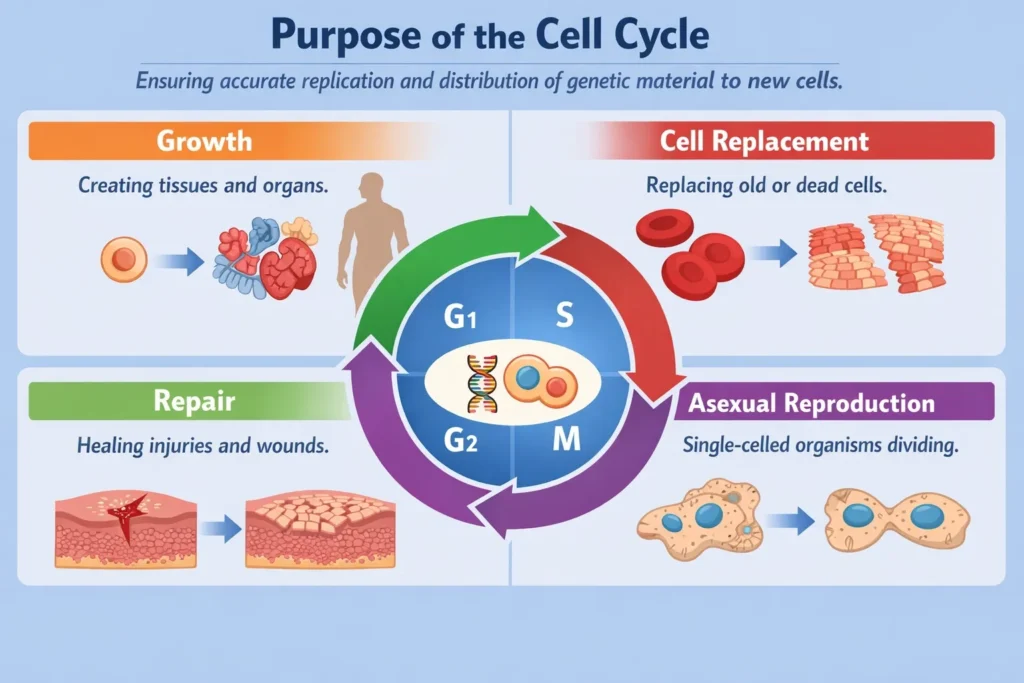
Ensuring that genetic material is precisely replicated and transferred to new cells is the main goal of the cell cycle.
These are the four particular causes of it:
- Growth: Humans and other multicellular animals begin as a single cell. To create tissues, organs, and an entire body, the cycle enables the cell to divide again.
- Cell Replacement: Your body is always losing cells. In order to replace worn-out or dead cells, such as red blood cells or skin cells, the cycle produces new ones.
- Repair: The cell cycle initiates fast division to fill the void left by an injury (such as a cut or a shattered bone).
- Asexual Reproduction: The cell cycle is how single-celled creatures, such as amoebas, reproduce and develop into whole new organisms.
Phases of the Cell Cycle
The sequence of actions that a cell goes through to reach maturity and then divide is known as the cell cycle or cell division. Its DNA is duplicated, cell organelles are synthesized, and the cytoplasm divides as a result.
Interphase: The Longest Phase (95% of the Time)
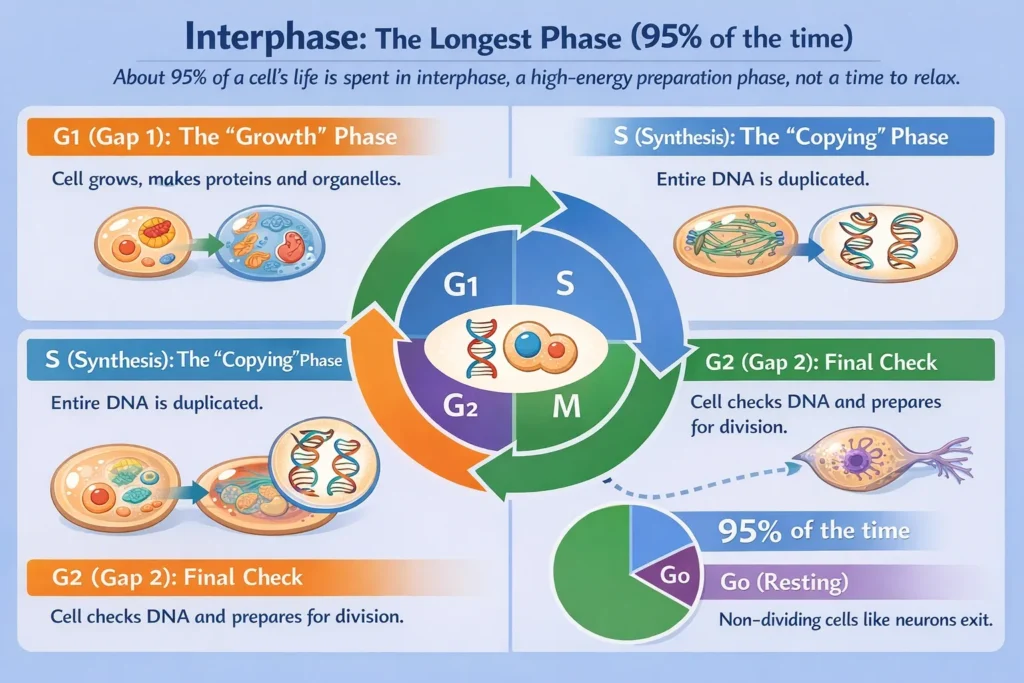
About 95% of a cell’s life is spent in interphase, which is the longest phase of the cell cycle. It’s a high-energy preparation phase, not a time to relax.
G1 (Gap 1): The “Growth Phase
This is the early years of the cell. The cell becomes larger and produces a vast amount of proteins and organelles, such as mitochondria. It keeps an eye on its surroundings to make sure it has enough resources to sustain a “baby” cell in the near future.
S (Synthesis): The “Copying Phase”
The most crucial time is now. The complete DNA of the cell is replicated. The cell has two full sets of genetic instructions at the conclusion of this stage, guaranteeing that both new cells will know exactly what to do.
G2 (Gap 2): Final Check
The cell completes a last inventory. It looks for “typos” (mutations) in the freshly duplicated DNA. Additionally, it produces unique microtubule proteins that will serve as the “tug-of-war ropes” to separate the chromosomes during the subsequent phase.
G0 (Resting)
Mature neurons and heart cells are examples of cells that leave the cycle at this point. They cease to divide completely yet continue to be active and carry out their biological functions.
M Phase: The Big Split (Mitosis)
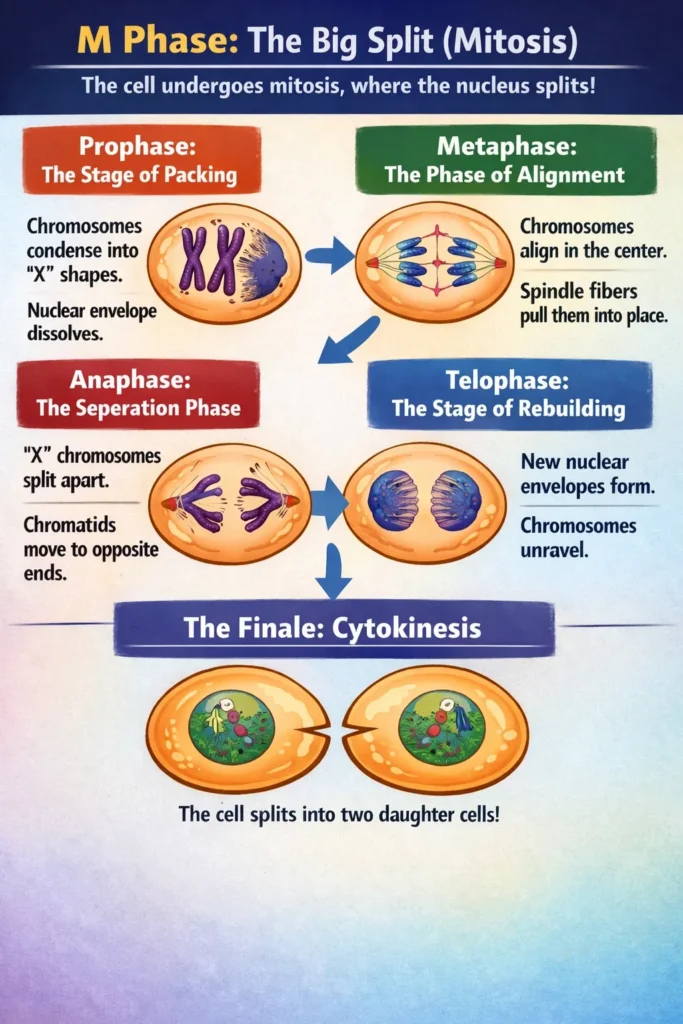
The cell undergoes mitosis, where the nucleus splits, after hours of preparation. This four-step dance is extremely well-coordinated:
Prophase: The Stage of Packing
Tight, discernible “X-shaped” chromosomes are formed when the free DNA strands coil together. To allow the chromosomes to travel freely, the nuclear envelope, the protective shell around the DNA, dissolves.
Metaphase: The Phase of Alignment
The chromosomes are pulled by the cell’s “tug-of-war” fibers, or spindles, until they are precisely aligned in the center of the cell. This guarantees that every gene is present in exactly one copy in every new cell.
The Separation Phase, or Anaphase
The “X” chromosomes are broken into two. The chromatids, the two identical halves, are drawn apart and toward the opposing ends of the cell.
Telophase: The Stage of Rebuilding
The laborious process is now complete. At either end, two fresh nuclear envelopes develop around the split DNA sets. The chromosomes start to unravel into loose strands.
The Finale: Cytokinesis
This is the last physical act, even though it is not officially a part of mitosis. The cytoplasm splits into two separate daughter cells when the cell membrane pinches in the center, resembling a drawstring bag tightening.
How is the Cell Cycle Regulated?
- A complex network of internal checkpoints that serve as security gates controls the cell cycle, guaranteeing that each phase is finished flawlessly before moving on to the next.
- The most crucial pauses take place at the conclusion of G1, when the cell examines the integrity of its DNA; at the end of G2, when it certifies that DNA replication is finished; and during Metaphase, when it validates that chromosomes are correctly connected for separation.
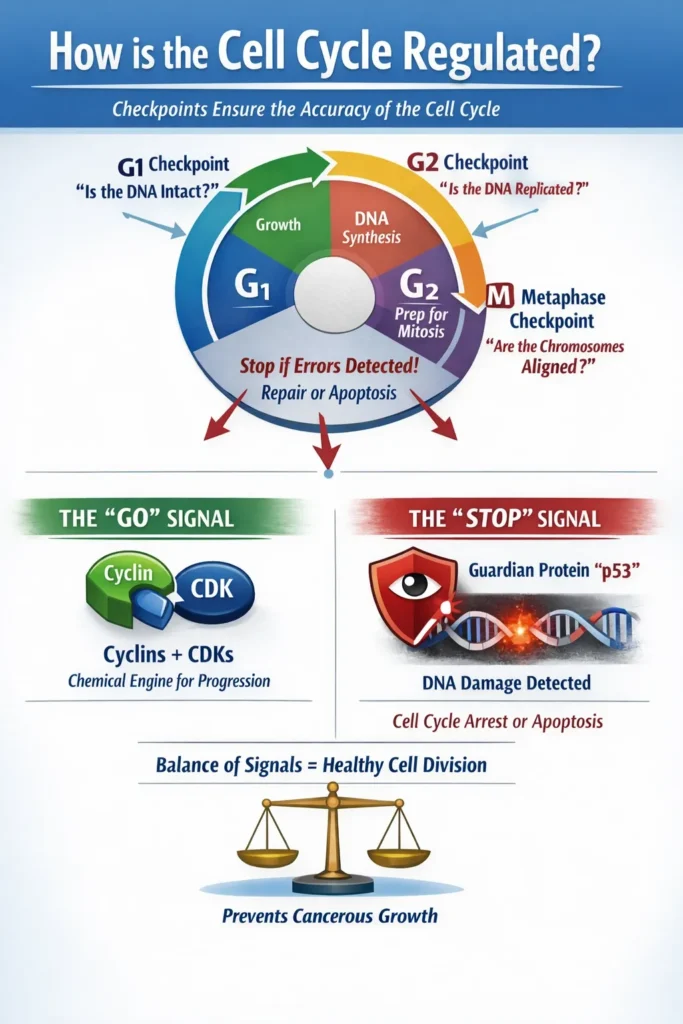
- In order to avoid passing on incorrect genetic information to the following generation, the cell will stop the process of doing repairs if it detects damage or faults at any of these places.
- A “chemical engine” composed of proteins known as cyclins and CDKs (Cyclin-Dependent Kinases) powers this control at the molecular level.
- Cyclins bind to CDKs to tell the cell to proceed, and their concentration varies during the cycle.
- In the meantime, “guardian” proteins like p53 serve as the brakes; they keep an eye on the genome and have the ability to cause apoptosis, or programmed cell death, when a cell is too damaged to be repaired.
- Healthy growth is maintained by this precise balance between “go” and “stop” signals, which also stops cancer’s unchecked division.